Valuing needlework samplers – and antiques in general!

Valuing
We’re often asked by our customers at fairs to value all sorts of pieces. If you are considering selling an item, here are some of the sorts of things which – collectively and generally speaking - we have personally found may have a bearing on the amount we will pay or the sale price we achieve for an antique sampler. These sorts of factors will apply to many other different types of antique or vintage pieces, be it a small piece of treen dating from Tudor times or an enamel sign from the 1950s!
Quality
Finely stitched, complex pieces are usually more desirable especially if the stitches are rarely seen e.g. open work and cut work compared with the more universal cross stitch. Having said this, we have customers who much prefer simple, naïve samplers!

Condition
Samplers in good condition invariably yield higher prices than faded examples caused by exposure to light or damage to the ground linen or stitches due to damp or insect attack. Once again though, we have a collector who much prefer to buy what she calls ‘ragamuffins’! The price paid for a sampler which needs considerable restoration will need to factor in the cost of this work.
Rarity
Types of sampler that rarely come to the market such as pocket watch samplers or two or more samplers stitched by the same person are very desirable, as are those worked by boys! Samplers commemorating a particular event like a battle, treaty or coronation are rare as are mathematical and musical samplers. Genealogical samplers depicting a family’s ancestry seldom come along.
Subject, composition, artistic merit and presentation
We have found that image rich motif samplers featuring houses, animals or people generally sell far more readily than more word heavy or band samplers. An appealing verse that still has a contemporary resonance (e.g. reference to kindness, gratitude or the environment) will be more attractive to most of our customers than a more melancholy text typically found in mourning samplers. Samplers worked in silk sell better for us than woollen examples. If a piece still has its original frame and even better old hand blown ‘bobbly glass’, then we are very happy people indeed!

Provenance
This can come in many guises. If a sampler can be shown to have a credible link to a particular person, such as from a family tree or other documentary evidence this will have a strong appeal. Samplers linked to noteworthy institutions such as the Ackworth Quaker School or Bristol Orphanage are very expensive to acquire! It rarely happens, but if the name or geographical origin of the stitcher is the same as a potential customer then this can trump most other considerations concerning the price they’re willing to pay!
Age
Clearly, all things being equal, the older a sampler is - the more it is worth. We would love to unearth, fresh to the market, a named a dated circa 1650 motif sampler - in fantastic condition!


The seller!
Dealers who have been in the trade for many, many years and who have built up exceptional expertise in their specialist area can, quite rightly, charge a premium for their pieces. In recent years, extraordinary prices have been realised when a sampler comes to the global market via the internet from a renowned family or celebrated collection. So, in 2012 a silk sampler by Mary Antrim, Burlington Country, New Jersey, Dated 1807 was sold by Sotheby’s in New York for a world record $1,070,500 – approximately £889,799 (see image)! More recently, in 2021 some 300 samplers and textile embroideries, dating from Charles I to the reign of Queen Victoria from the ‘Feller Collection’, were sold by Salisbury (UK) based Woolley and Wallis auctioneers. The highest price realised (£7,500) was for a sampler worked by Sarah Ruskin dated 1802 and depicting a shepherd with his flock (see image). It is interesting to note that age was not the overriding price consideration for the successful buyers of either of these samplers since older samplers were on offer at both auctions. Further information about both Mary and Sarah’s stunning samplers is readily available online!
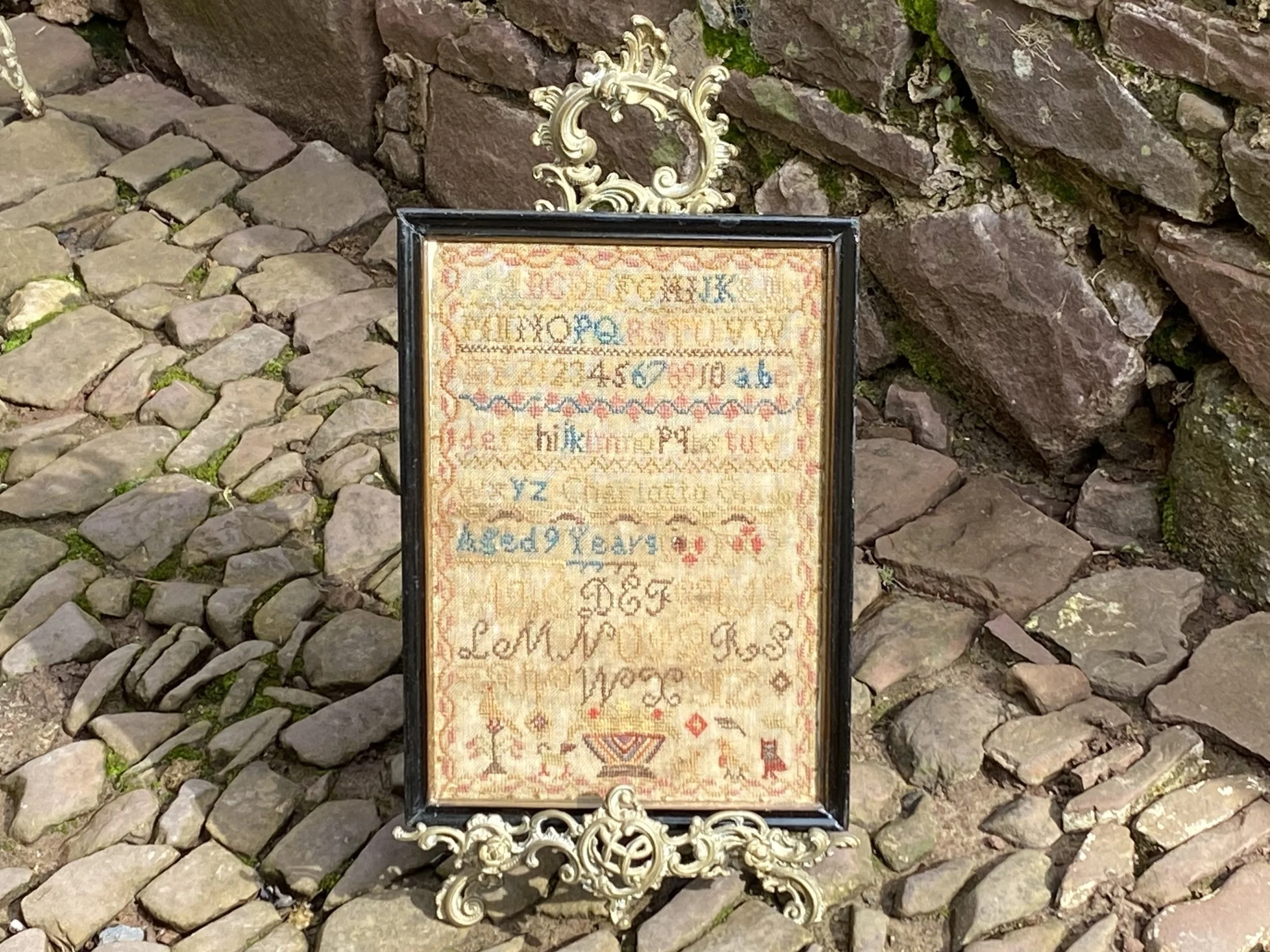
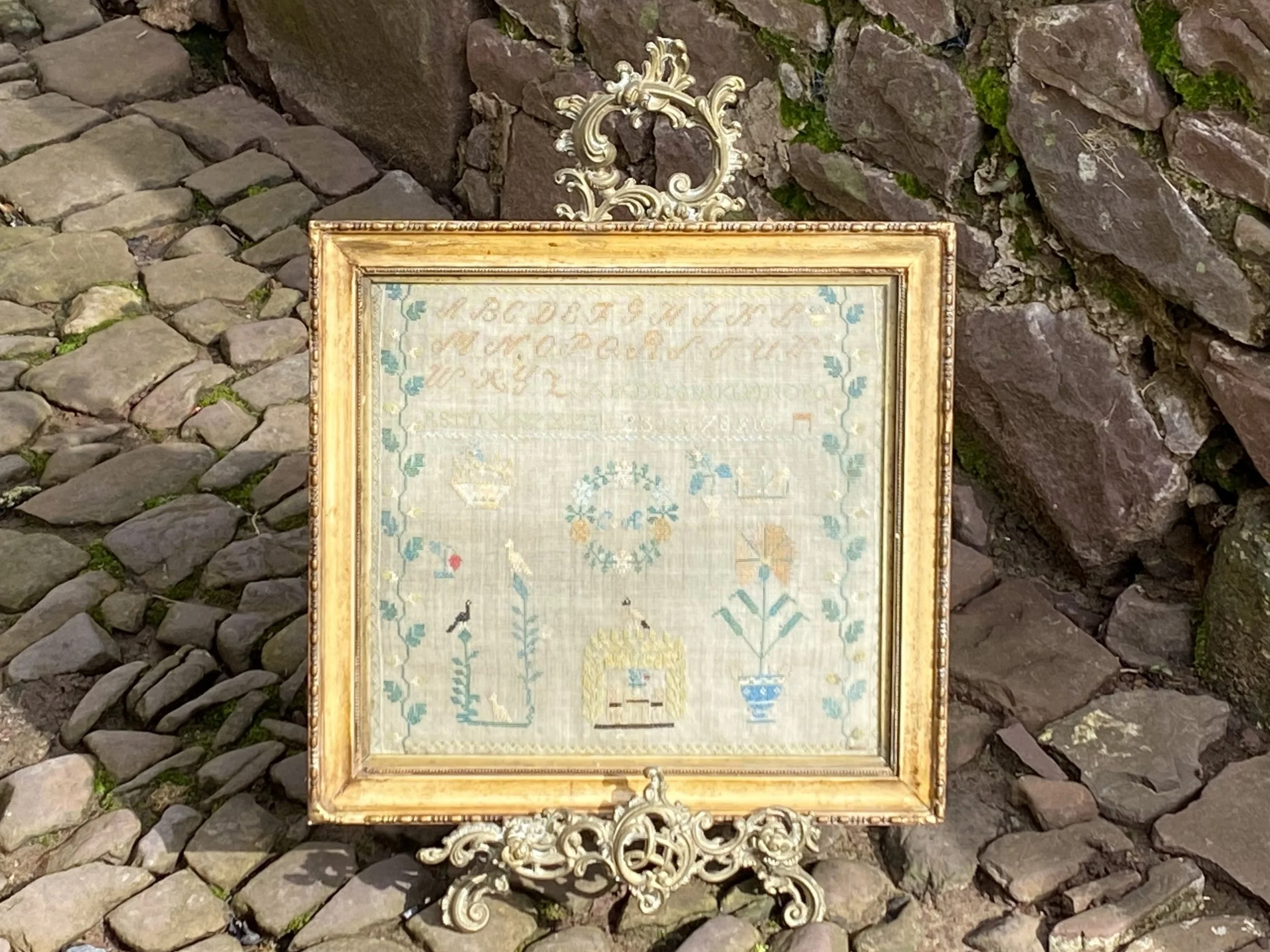
We hope that you find our blog interesting! Please have a look at the samplers we currently have available, to see how the above pricing factors play out when applied to our stock! The six illustrative samplers within this Blog reflect examples across the price range we had available at the time of writing. If you have a sampler or any antique or vintage piece that you’d like us to consider buying, visit the ‘Something to sell?’ page of our website.

At Sotheby's, New York, USA in January 2021 the silk sampler above achieved the current best global price! It was worked by a schoolgirl and realised $1,070,500 – approximately £889,799!
December 2022

A George III needlework pictorial by Sarah Ruskin



A better price may be available. Please enquire below.
Description
This lovely piece features an impressive Solomon’s Porch motif flanked by two ornamental clipped conifers & approached by a gated lawn, defined by two decorative pillars. Rare crow & butterfly motifs further adorn the piece. The verse "Jesus permit thy gracious name to stand ..." (Rev. John Newton 1725–1807) is very typical of samplers from this period. Original period ebonised frame.
Additional Comments
Harriet’s Solomon’s porch is very representative of the genre. It has a central tower, flanked by two further smaller towers, each with its own castellated roof above a central arched doorway. In comparison to some other buildings depicted in samplers, Solomon’s Porch motifs are evident less often than houses, but more frequently than churches. The earliest examples of Solomon’s Porch in Britain appear on late band samplers dating from the early 1700s, where the motif is placed centrally within the sampler. The earliest known example is in the Dorset County Museum and dates to 1734/5. Harriet’s work is in excellent condition with minimal fading, no stitch loss & just some unobtrusive loss to the linen ground. The Reverend John Newton was the noted English Evangelical Anglican cleric & slavery abolitionist. The sampler is fresh to the digital market.
In our view, the quality & excellent, condition of this beautiful piece - in addition to the fact that it was completed over 180 years ago - make it a very desirable example of this sought after genre of sampler.
Conservation & Restoration
We have prepared Harriet’s stunning sampler for sale by taking it from its original frame, the paper to which it was attached (see sample to rear - in our view the sampler has unlikely to have ever been removed from its frame!) & removing the surface dust from it using a conservation vacuum cleaner. It has then been stitched onto complementary fresh linen which rests on cotton wadding glued to an acid free mount. All components of the frame have been thoroughly cleaned & the veneer waxed. Finally, the sampler has been re-presented in its frame behind a piece of new board backing secured by stainless steel panel pins & sealed with self-adhesive picture framing tape. The piece is ready to hang using new (doubled) picture string attached to the frame’s original period eyes.
Framed Dimensions (W, H & D): 37x39x2.5 cm
Ref: S26